
 Facebook
 YouTube
 Twitter
What will happen if the world goes cashless? Verifique isto – What would happen if we went cashless
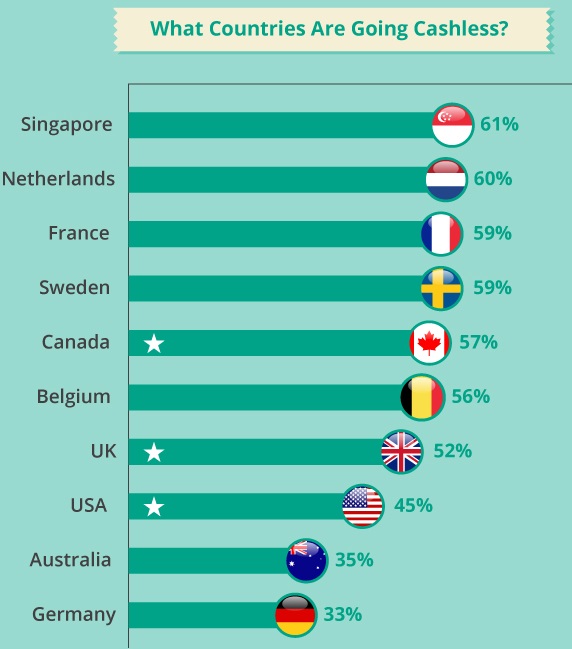
The downsides of going cashless include less privacy, greater exposure to hacking, technological dependency, magnifying economic inequality, and more. Credit and debit cards, electronic payment apps, mobile payment services, and virtual currencies in use today could pave the way to a full cashless society.Cashless society: disadvantages
Elderly people may be less comfortable with tech and less able to make the switch from physical currency. Rural communities could also be left vulnerable, because of poor broadband and mobile connectivity. People with low income or debt tend to find cash easier to manage too.
Despite the trend toward a cashless society, cash is still king. It plays a vital role in financial accessibility. Cash will undoubtedly remain for the foreseeable future despite accelerations by the pandemic.
A cashless economy reduces the chance of black money entering the system and completely decrease nefarious activities. Cash-based economy usually facilitates easy abetment of criminal activities such as money laundering, terrorism, extortion etc.
Will cash ever go away
Ultimately, cash may in fact disappear. But it's mostly a question of where and when. While it may disappear in some countries, it might remain in others. And if it ultimately happens in 50 or 100 or more years, it won't matter much to anyone who's alive today.A cashless society is a society where all physical money (cash, checks and coins) is completely and totally replaced by digital currency—and that includes replacing debit and credit cards too.There are multiple reasons why a number of people continue to prefer and demand cash. And not all of them are reasons of practicality or usage. Instead, the reasons are more personal, such as the immediacy and feel of money, or the difficulties of accepting and enabling digital payments.
Cash is still alive and well, and no pandemic can take it down. Like it or not, there are plenty of people who like and rely on using cash bills. And as long as those people are around, no, we won't be moving to a cashless society anytime soon.
What country is a cashless society
Sweden
In Sweden, technology is close to making cash a thing of the past. All aboard with the cashless society Sweden has been at the forefront of banking innovation for a long time. The country's first automatic cash machine was inaugurated in July 1967, only a week after the world's very first one was opened in London.In 2023, Sweden is proudly becoming the first cashless nation in the world, with an economy that goes 100 percent digital.“Cash will continue to decline globally in favor of electronic payments for everyday transactions and we expect most markets to be functionally cashless by 2030,” Karakoy said.
We have been issuing banknotes for over 300 years and make sure the banknotes we all use are of high quality. While the future demand for cash is uncertain, it is unlikely that cash will die out any time soon.
Debit cards and electronic transfers are replacing physical money, leading to a system where governments, banks, businesses, and people transfer funds by having a third party change numbers on the equivalent of an electronic ledger.
It's not likely that paper money will completely disappear at any time in the near future. It is true that electronic transactions have become more and more common over the last few decades and there is no reason why this trend will not continue.
Why should the US not go cashless
There are many reasons experts list in arguing that cash must remain a viable payment option: Going cashless excludes the millions of unbanked and underbanked people in America, most of whom are people of color; cash is the best way to pay while maintaining a modicum of privacy; cash is integral to many cultural …Sweden. Although it was the first country to issue banknotes, Sweden is the most cashless society in the world today, with just 32 ATMs in operation per 100,000 people, and with more than 98% of its citizens own a debit/credit card. It also ranks as one of the top countries utilising mobile payments.Luckily, it's unlikely that we will completely do away with cash — at least not any time soon. This means more time for small businesses to get comfortable before they take the mandatory leap into digital payments. 71% of consumers intend to continue using cashless payments in the future.